HPLC Purity vs Mass Spec Identity: Why 99% Does Not Tell the Whole Story
HPLC purity and mass spectrometry identity are different quality signals. This guide explains what each one proves and what each one cannot prove alone.
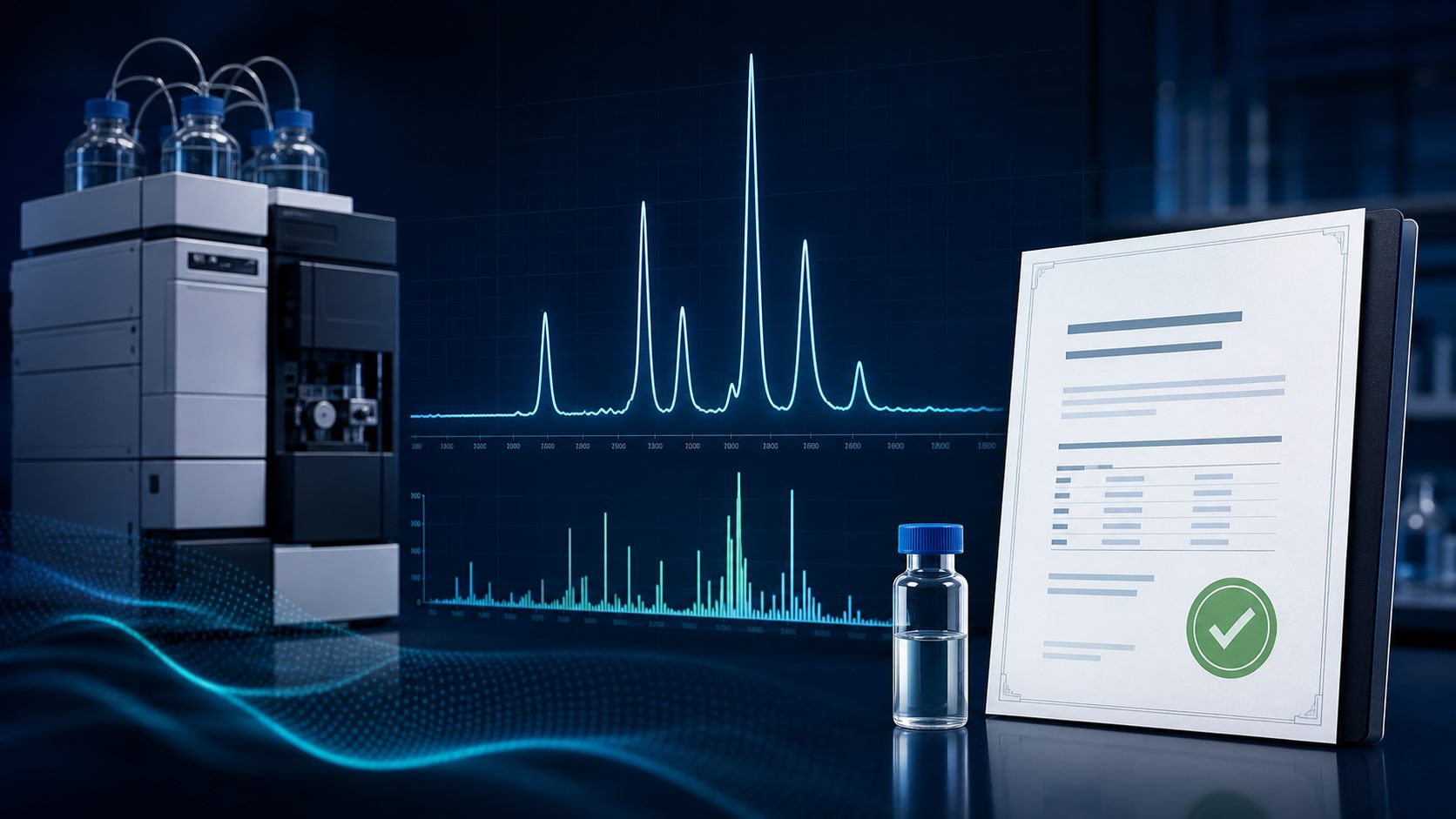
HPLC purity and mass spectrometry identity are often mentioned together, but they do not mean the same thing. For peptide sourcing, confusing them can make a supplier look stronger than the documentation actually supports.
What HPLC purity can tell you
HPLC separates the sample into peaks under a defined analytical method. If the target peak represents 99% of the detected signal, the report may state 99% purity. That is useful for estimating related impurities, but the result depends on method setup and does not by itself prove the molecule is the intended peptide.
What mass spectrometry adds
Mass spectrometry compares observed molecular mass with the expected mass of the peptide. It helps answer the identity question: is the dominant material consistent with the molecule on the label? This is why a strong report usually includes both purity and identity evidence.
Why 99% can still be incomplete
A clean HPLC chromatogram can still be incomplete if the main peak is not confirmed by mass data, if the lot number is missing, or if the method does not reveal certain modifications. The number is a starting point for review, not the whole quality story.
Useful comparison table
| Question | Best evidence | What it does not prove alone |
|---|---|---|
| How pure is the sample? | HPLC chromatogram and integration | Exact molecular identity |
| Is the molecule likely correct? | MS or LC-MS observed mass | Full impurity profile |
| Does it match my order? | Lot-specific COA and label match | Long-term storage history |
| Can I reproduce procurement records? | Batch number, date and supplier response | Experimental suitability |
Bottom line
HPLC purity asks how clean the detected sample appears under one method. Mass spec identity asks whether the molecule is consistent with the expected peptide. Good procurement review needs both questions answered.
All products discussed are supplied strictly for laboratory research use only.
Research use only. Educational commercial content.