How to Store Lyophilized Peptides: A Practical Lab Guide
Temperature, reconstitution solvent, aliquoting, and the freeze-thaw rules that actually affect peptide integrity.
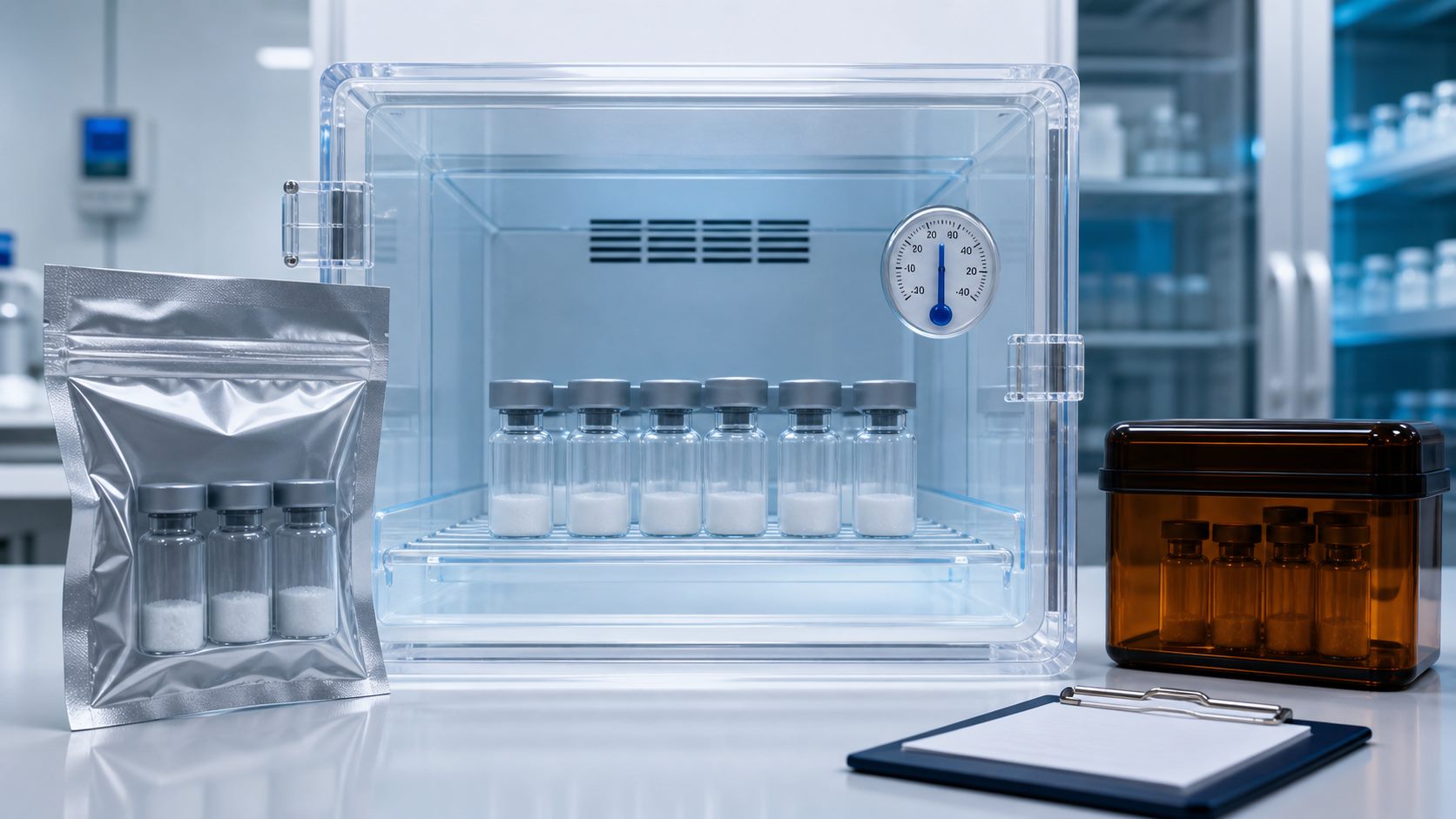
Peptide stability is one of the most-cited and least-reproduced areas of laboratory peptide handling. The fundamentals are well established, but small deviations — repeated freeze-thaws, choice of solvent, exposure to light — compound across a study and can confound results long before anyone suspects the material.
Lyophilized storage
- Store at -20°C or colder for long-term archival (≥6 months)
- Acceptable at 2–8°C for short-term storage (weeks)
- Protect from light; amber vials or foil overwrap are standard
- Avoid humidity exposure — moisture compromises lyophilized cake integrity
Reconstitution
Bacteriostatic water (0.9% benzyl alcohol) is the standard solvent for laboratory reconstitution and provides multi-week refrigerated stability. Sterile water is acceptable for single-use protocols. Add solvent slowly down the vial wall — never directly onto the lyophilized cake — and allow passive dissolution; vortexing can shear sensitive peptide bonds.
Aliquoting
For chronic-dosing studies, aliquot reconstituted material into single-use volumes immediately after dissolution. Each freeze-thaw cycle of an aqueous peptide can degrade 5–15% of intact molecule depending on sequence sensitivity. Aliquoting is the single most impactful change most laboratories can make to their handling protocol.
Refrigerated shelf-life by class (general guidance)
- Stable GLP-1 class (semaglutide, tirzepatide, retatrutide): ~28–30 days at 2–8°C
- BPC-157 / TB-500: ~14–30 days at 2–8°C
- Short peptides (Epitalon, Ipamorelin): up to 30 days
- GHRH analogs (CJC-1295 no-DAC): ~14–21 days
Documentation
Label every vial with reconstitution date, solvent, and concentration. Maintain a chain-of-custody log for any material crossing between researchers. Reproducibility is built at the bench, not in the manuscript.
Research use only. Educational commercial content.