GHK-Cu Skin Healing Research Guide: Copper Peptide Mechanisms Explained
An original research-focused guide to GHK-Cu copper peptide, skin-healing models, fibroblast signalling, collagen remodeling, antimicrobial research and COA checks.
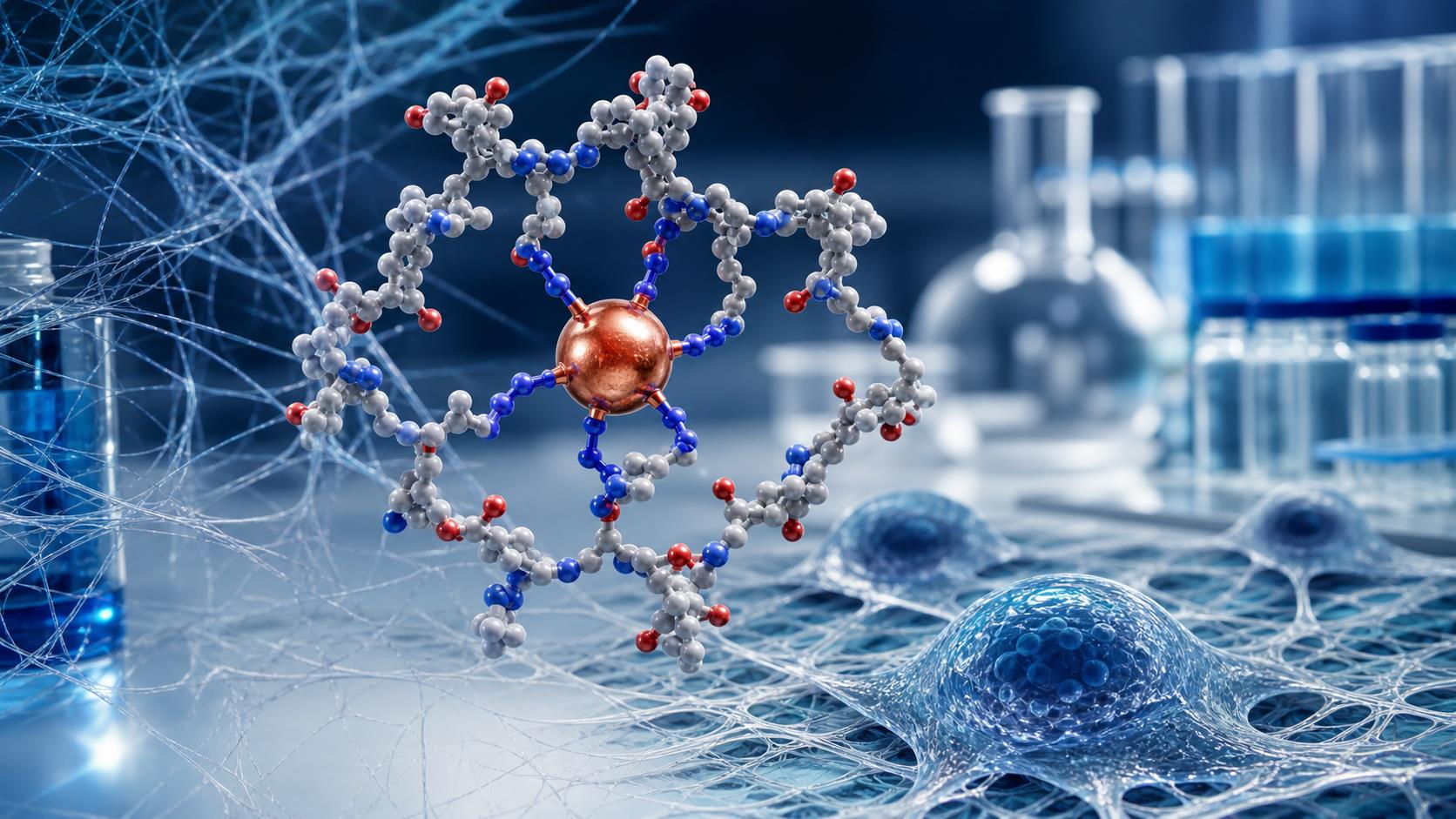
GHK-Cu is one of the best-known copper peptides in regenerative and skin-biology research. The compound is a copper complex of the naturally occurring tripeptide glycyl-L-histidyl-L-lysine, often discussed because copper binding connects peptide signalling with extracellular-matrix remodeling, oxidative-stress control and tissue-repair pathways.
What is GHK-Cu?
GHK is a three-amino-acid peptide made from glycine, histidine and lysine. The histidine residue gives the peptide strong copper-binding behavior, forming the GHK-Cu complex. Researchers became interested in the molecule because it appears in human biological fluids and has been studied in models involving dermal fibroblasts, collagen regulation, wound-repair signalling and inflammatory response.
Why copper binding matters
Copper is a cofactor in several enzymes involved in connective-tissue biology and redox balance. In GHK-Cu research, the copper complex is often treated as more than a passive carrier: it is studied as a signalling molecule that may influence gene expression, matrix turnover and repair-associated cell behavior. That is why researchers usually distinguish free GHK from the copper-bound GHK-Cu form.
Skin and tissue-repair mechanisms studied
| Research area | What is studied | Why it matters |
|---|---|---|
| Fibroblast activity | Changes in dermal fibroblast growth and repair-associated signalling | Fibroblasts help organize extracellular matrix and collagen remodeling |
| Collagen and elastin biology | Matrix protein synthesis, breakdown and turnover | Skin structure depends on regulated matrix remodeling, not simple stimulation |
| Inflammatory signalling | Cytokine patterns and anti-inflammatory markers | Repair requires controlled inflammation rather than permanent suppression |
| Oxidative stress | Antioxidant enzyme activity and free-radical damage markers | Oxidative damage can interfere with tissue recovery and matrix integrity |
| Scar remodeling | TGF-beta linked pathways and hypertrophic-scar models | Scar quality depends on how repair signalling resolves over time |
What skin-healing claims often oversimplify
Many online articles describe GHK-Cu as if it directly makes skin heal or become younger. That wording is too broad for a research-material supplier. The stronger interpretation is that GHK-Cu has been studied in systems connected to wound repair, fibroblast behavior, extracellular-matrix remodeling, collagen regulation and inflammatory balance. Those research signals do not turn a laboratory material into a cosmetic, medicine or human-use product.
Antimicrobial and tissue-protection research
Some studies have explored GHK-related conjugates and copper peptide systems for antimicrobial activity against bacteria and fungi. This area is separate from cosmetic claims and should be read as early-stage laboratory research. The structure of the conjugate, testing conditions and organism studied all matter; broad claims such as "works like an antibiotic" are not careful enough for procurement decisions.
GHK-Cu compared with AHK-Cu
GHK-Cu and AHK-Cu are both copper peptides, but they are not interchangeable. GHK-Cu is more commonly discussed in skin remodeling, tissue repair and gene-expression literature. AHK-Cu appears more often in hair-follicle and dermal-papilla research contexts. The right comparison depends on the tissue model and endpoint, not on which compound sounds more general.
Documentation checklist before ordering GHK-Cu
- Confirm the exact compound name and copper complex form.
- Check that the COA or batch documentation matches the current lot.
- Look for HPLC purity information and identity confirmation where available.
- Review storage conditions for lyophilized material.
- Avoid suppliers that mix research material language with cosmetic or human-use claims.
Storage and handling overview
GHK-Cu is typically supplied as a lyophilized research material. Long-term storage should protect the peptide from heat, light and moisture. As with other peptides, repeated freeze-thaw cycles and unclear reconstitution records can complicate reproducibility. Any working solution should be labelled with solvent, concentration and preparation date.
GHK-Cu FAQ
Is GHK-Cu a cosmetic product?
Not when supplied by PeptidesLab. It is sold strictly as a laboratory research material and is not intended for cosmetic, medical, human, veterinary, food or supplement use.
What makes GHK-Cu different from ordinary GHK?
GHK-Cu is the copper complex of the GHK tripeptide. Copper binding changes the research context because copper-dependent biology is connected to matrix remodeling, redox control and repair-associated enzyme systems.
Does PeptidesLab provide application or dosing guidance?
No. PeptidesLab does not provide application, administration, dosing, cosmetic-use or therapeutic-use guidance.
Bottom line
GHK-Cu is valuable to researchers because it connects copper peptide chemistry with dermal fibroblast behavior, matrix remodeling, inflammatory signalling and tissue-repair models. The responsible way to evaluate it is through mechanism, documentation and research context, not through broad skin-healing promises.
Sources reviewed
- Pickart L. The human tri-peptide GHK and tissue remodeling. J Biomater Sci Polym Ed. 2008.
- Gruchlik A, Chodurek E, Dzierzewicz Z. Effect of GLY-HIS-LYS and its copper complex on TGF-beta secretion in normal human dermal fibroblasts. Acta Pol Pharm. 2014.
- Kukowska M, Kukowska-Kaszuba M, Dzierzbicka K. In vitro studies of antimicrobial activity of Gly-His-Lys conjugates. Bioorg Med Chem Lett. 2015.
- Li H et al. Microneedle-mediated delivery of copper peptide through skin. Pharm Res. 2015.
GHK-Cu materials discussed by PeptidesLab are for laboratory research use only. Not for human, veterinary, medical, cosmetic or supplement use.
Research use only. Educational commercial content.